Friday, August 23, 2019

A New Ukrainian Memories Archive

An interesting new Ukrainian online platform on oral history and memory has been launched recently, available at https://memory.org.ua/.

The project aims at collecting personal stories of Ukrainians in various historical contexts, like Second World War, deportations, repressions, the Holodomor, emigration etc.


You can search the stories by chronology, or by key words.  You can also upload your or a relative's memories on the website.

The website and the search is in Ukrainian only, but can be used with a translating tool.

For now the archive does not have a large collection, but if the project succeeds, it could become a useful tool for Ukrainian family research.

Tuesday, August 13, 2019

Top Online Genealogy Resources for Galicia, Austro-Hungary


This post is based on my recent presentations at the FEEFHS 2019 conference, where I talked in detail about the archival and online resources for Eastern Galicia.

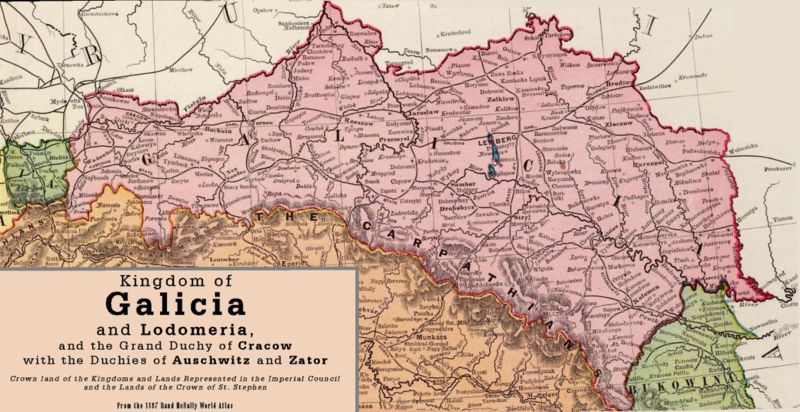
Galicia (English: Galicia, German: Galizien, Ukrainian: Halychyna (Галичина), Polish: Galicja) was a multi-ethnic historical region, shaped as a province of the Habsburg empire.


Galicia was part of Poland in the inter-war period. It was occupied by the Nazi Germany during WWII. After the war, Galicia was split into Western and Eastern parts between Poland and Soviet Union. Nowadays Western Galicia belongs to Poland, while Eastern Galicia is part of Ukraine.

So, here is my selection of the best online resources to start with, when researching your Galician ancestors.

Primers

FamilySearch Wiki on Galicia
Foundation for East European Family History Studies page on Galicia
Himka, John-Paul. Galicia and Bukovina: a research handbook about Western Ukraine, late 19th and 20th centuries, 1949-, Alberta.

Online Maps

Mapire:
Galizien und Lodomerien (1779–1783) - First Military Survey
Galicia and Bucovina (1861–1864) - Second military survey of the Habsburg Empire
Habsburg Empire (1869-1887) - Third Military Survey (1:75000)


Mapping Galician Jewish Communities
GesherGalicia Map Room: Regional and cadastral maps
A guide on working with cadastral maps of Galicia.


Gazetteers, Town Locators

Słownik Geograficzny Królestwa Połskiego i innych krajów słowiańskich (Geographical Dictionary of the Kingdom of Poland and other Slavic lands), 1880.15 vols.
Bystrzycki, Tadeusz. Skorowidz mieiscowosci rzeczypospolitej polskiej
(Listing of Localities of the Polish Republic), 1934. 2 vols.
Gesher Galicia’s Galician Town Locator


Records and Databases Online

FamilySearch Catalog for Galicia. Also search for your specific town (Tips on how to do it on A Step-by-Step Guide to Finding Digital Images in the FamilySearch Catalog)
Austrian Military records from Galicia, 1865-1930
Unified search of Polish state archives Szukaj W Archiwach Central Archives of Historical Records in Warsaw (AGAD) online records 
Database by Polish Genealogical Society Geneteka. A How-to guide.
Miltary records from Eastern Galicia, 1865-1930.
Military records: Ruthenian battalion of mountain riflemen, 1849-1850
Military records from Transcarpathia on Family Search
Western Ukraine Catholic Church Book Duplicates, 1600-1937: Indexes of baptisms and images of baptisms, marriages, and deaths for Catholics living in the parishes of Eastern Galicia.
The All-Galicia database by GesherGalicia: 
Galicia, Business Directory, 1891 
JRI Poland, Jewish Record Indexing Poland
Galicia, Ukraine, Births, Marriages, and Deaths, 1789-1905: an index from Jewish vital records from Eastern Galicia. 
Stanislawow Census 1939


Dedicated Websites

Genealogy of Halychyna / Eastern Galicia 
Gesher Galicia 
Jewish Galicia and Bukovina 
Galicia Jewish Museum
Germans from Galicia 
Galizien German Descendants 
Galizien-Online 
Galizien Deutsche

Blogs

Forgotten Galicia Blog


Halychyna! Galicia! Galicja! Galizien! Gácsország!
Selection of Books about Galicia

Facebook Groups

Galicia Family History Group
Galizien German Genealogy Group


Monday, July 29, 2019

Crossing Historical Borders in the Carpathians


Recently I have been on a mini-vacation, hiking in the Carpathian mountains. These mountains stretch across a number of Eastern European countries: Czech Republic, Slovakia, Poland, Hungary, Ukraine, Serbia and Romania. 

My trip was from Budapest, Hungary, via the region of Maramureș, Romania, to Zakarpattya and Ivano-Frankivsk regions of Ukraine. This is a very picturesque area, with hills, valleys, rivers and, of course, mountains.


As it happens in Eastern Europe, we crossed a number of current borders:
the European Union and Schengen area borders, as well as Hungarian-Romanian and Romanian-Ukrainian state borders. But also typically for this area, we crossed multiple historical borders: the one of the Kingdom of Hungary and Austrian monarchy, between historical regions Maramoros, Carpathian Ruthenia and Galicia, as well as Romania - Czechoslovakia and Czechoslovakia - Poland inter-war borders.

The 1920 border between Czechoslovakia and Poland was even represented by physical artifacts - concrete border columns on top of the ridge along one of the hiking trails.


The hiking trail along the 1920 border. On the right side you can see one of the columns.

Lopsided, covered with moss and mold, the inscriptions on the columns were still readable. Letter "P" on one side stands for Poland, and "CS" on another side stands for Czechoslovakia. 1920 is the year, when the border was demarcated.

A border stone on top of peak Turkul

"CS" for Czechoslovakia. 1920.

"P" for Poland. 1920.

On top of the stone there were notches in the direction of the next border stone.


Nowadays this is the administrative border between Transcarpathia (formerly Czechoslovakia) and Ivano-Frankivsk (Galicia, formerly Poland) regions of Ukraine.


In this area borders changed very frequently even by Eastern European standards. This is why researching ancestors from Carpatho-Ruthenia and Galicia is so challenging, yet so fascinating.

Sunday, June 2, 2019

A New Database on Hungarian Refugees, 1918 - 1928


http://gallery.hungaricana.hu


A new online database, that can be used for Hungarian genealogy research, has become available and searchable both in Hungarian and in English. If you have ancestors or relatives, who lived in Hungary during and after First World War, it is worth checking out.

The database includes over 15,000 names of those, who fled to Hungary from its former territories in the aftermath of WWI, between 1918 and 1928. The data contains their names, as well as previous place of residence, occupation and the place of arrival in Hungary.

The sources for the database were the documentation of the Hungarian Railways, other archival documents, information from the local newspapers, in particular, Erdélyi Hírek (Transylvania News), reporting on the arrival of refugees in 1920-1921.

The project was completed jointly by the Trianon 100 research team, Noran Libro Publishing House and István Dékány, the author of "The Orphans of Trianon" book. It is dedicated to the upcoming 99th anniversary of the Trianon Treaty. Hungarian speakers can watch this video on the creation of the database. 


Sunday, May 26, 2019

Genealogical Data Supports the 'Grandmother Hypothesis'


Source: https://www.facebook.com/KompotIsLife/

The so-called grandmother hypothesis suggests that as humans started to live longer, grandparents began to play a crucial role in reproductive success. With the appearance of grandparents more human babies were born, and they were more likely to live longer.

Earlier this year, two new studies, published in Current Biology, were reported to add evidence for this theory. Interestingly, in these studies biologists and anthropologists used the kind of documents that genealogists normally work with: population censuses and church records. Specifically, they analyzed these records in terms of the effect grandmothers had on their grandchildren’s number and survival.

Canadian researchers analyzed the data of the pre-industrial French settlers in the St. Lawrence Valley during the 17th and 18th centuries. Their study confirmed that reproductive success was higher when grandmothers were alive. Grandmothers who were alive allowed their daughters to increase their number of offspring born by 2.1 and to increase their number of offspring surviving to 15 years of age by 1.1 compared to when grandmothers were dead.

This effect decreased with grandmothers living far away from their daughters. As geographic distance increased, the number of offspring born and lifetime reproductive success decreased.

A team of researchers from Finland worked with birth and death records from the Finnish church books from 1731-1895. They found that having a maternal grandmother aged 50–75 improved grandchild survival. Women, whose mothers were not living nearby, had higher chances of death.

However, there were age limitations to the grandmothers' ability to provide help to young grandchildren. Researchers found that co-residence with paternal grandmothers aged 75+ decreased grandchild survival. It is not clear from the summary, however, whether or not the paternal lineage was a factor in this case. Maternal vs. paternal grandmother roles is subject to a whole scientific discussion. But in this case it might be simply because of the pre-industrial family structure: co-residing with paternal grandparents was more common.

In any case, it looks like genealogical data provides support to the "grandmother hypothesis". Children who were cared for by older women in the family had better chances of survival. The biggest positive effect on the grandchildren fitness and survival was from the maternal grandmothers aged 50–75, who lived in vicinity with their grandchildren.

I have not found similar research with Eastern European records, but it would be interesting to have more of such cross-disciplinary studies. As Eastern European genealogists, we could call it "the Babushka effect".


Friday, April 26, 2019

Were Frida Kahlo’s Ancestors From Hungary?


For decades it had been widely accepted that Frida’s paternal ancestors were Jews from Hungary, based on her own words. She wrote in her diary the following: “My paternal grandparents, who were Hungarians, were born in Arad, Hungary, and moved to Germany, when they were already married. It was here, in Baden Baden, that their children, including my father Guillermo Kahlo, were born.” Arad is a town in Romania, that used to be part of the Kingdom of Hungary. It came as a complete surprise, when in 2005 German researchers Gaby Franger and Rainer Huhle published a book, in which they demonstrated that Frida’s father Guillermo Kahlo’s ancestors were Lutherans from Germany at least since the 18th century. 


My Grandparents My Parents and Me, 1936 by Frida Kahlo. Source: www.fridakahlo.org

A quick last name analysis of the surname Kahlo also suggests its German origin. This surname distribution map shows Kahlo as a valid, but relatively rare surname, with 83 representatives currently living in Germany. There is a similar last name, Kahl, which is much more common in modern Germany. The two could have the same root. Also, records from the FamilySearch database show people named Kahlo mostly being from Germany.

Although Franger and Huhle’s research seems to give a definitive answer, there are still many questions in this story. Naturally, in Hungary there is a vivid interest to this aspect of the painter’s biography. One of the focal points of Frida Kahlo exhibition in the Hungarian National Gallery in Budapest, Hungary, held in July-November 2018, was her connection to Hungary. Even though the curator of the exhibition Adriana Lantos acknowledged the lack of evidence for Kahlo's Hungarian roots, the respective exhibit seems to leave the question open: “We can only trust that new, earlier unknown documents will become available in the future that will reveal the truth of the matter”.

Picture taken at the Frida Kahlo exhibition in Budapest, 2018

So, why did Frida maintain that her father was of Jewish Hungarian origin?


There are a couple of speculations. Some researchers think that she did not want to associate herself with Germany because of WWII, and for the same reason she may have liked the idea of being Jewish. This hypothesis is supported by the fact that Frida did not mention her Jewish origin until 1936, when antisemitic legislation was adopted in Germany.

As to the Hungarian identity she claimed, many think it is connected with Nickolas Muray, a famous photographer of Hungarian Jewish origin, with whom she had a decade-long relationship. Muray's photography was published in Harper’s Bazar, Vogue and The New York Times. He also competed at the 1928 and 1932 Summer Olympics in the fencing events.

Now, if with the Jewish and Hungarian identities there are some plausible speculations, it is harder to come up with an explanation of how Arad came into the picture. A publicist from Transylvania Péter Puskel mentions his futile efforts to investigate Frida’s possible connection to Arad.

My own quick online research on Muray’s ancestry did not reveal any apparent connection with Arad, either. He was born as Miklós Mandl in Szeged, Hungary, in 1892. Although Szeged is only 100 km (about 62 miles) away from Arad, it is not enough to assume a connection here. Miklós' birth record lists his father as Samu Mandl, a grocer from Albert Irsa and his mother as Klára Lóvit from Nagy Abony. Albertirsa was located in Pest county, while Nagy Abony, now called Veľké Blahovo, is in Slovakia. 

At Miklós' birth record there is a note, that he changed his surname to “Murai”. So, his emigration to the U.S. was already under this last name. As per Nick Muray’s naturalization files, he immigrated in 1913. I found a 1914 ship manifest of his brother Stefan Murai, whose contacts were father Samu in Budapest and brother Nicholas Muray in Brooklyn, NY. Stefan’s place of birth is rather difficult to read, but it looks like “Kispest, Delegyhaza”, which may be Délegyháza in Pest county. So, again, Arad is nowhere is sight…

Another Frida’s known Hungarian connection was Martin Munkácsi (born Márton Mermelstein), also an American photographer of Jewish Hungarian descent. He was the author of a number of famous photos of Frida and her husband Diego Riviera. Martin Munkácsi was born in born in Kolozsvár, then Hungary, now Cluj-Napoca in Romania. Even though both Cluj and Arad are part of Transylvania region, it is still not providing enough explanation of Frida’s “choice” of her paternal ancestral town.
 
And lastly, another touch to Frida’s Hungarian mystery: a copy of the letter she wrote in Hungarian to Nickolas Muray. It was on display at the exhibition.


Source

Translation:

Nick,

I love you like an angel. You are a lily-of-the-valley, my dear. 

I will never forget you, never, never. 
You are my whole life. I hope that you will not forget this, either. 
Frida.


The language of the letter is quite curious. On one hand, the text is in proper Hungarian. On the other hand, it has multiple spelling mistakes (like missing diacritics, compound words written separately, etc.). It feels like it was either written by a Hungarian native speaker, who did not learn how to write properly (as it happens, for example, with émigré children), or by a non-native who wrote down a phrase learned by ear. It is not known, whether Frida indeed wrote this letter on her own, or got help from a Hungarian acquaintance.
In any case, there are many sides to this puzzle.


Thursday, August 2, 2018

How To Search for Russian WWI Records Online


Some time ago I have written about online resources for Second World War Soviet records, which can be accessed here. There has been a great interest in the First World War research, as well, especially as this year will mark the 100th anniversary of the end of the Great War. The number of participants and casualties were so great, that most Europeans had ancestors or relatives involved in WWI.

In this post I will put together the top online resources for researching individuals fighting in WWI in the Russian Imperial army. It is estimated that 1,700,000 Russian soldiers and officers were killed and 3,749,000 were wounded in this war. Naturally, these resources do not only include the territory of contemporary Russia, but also other territories, that were part of the Russian empire at the time. Although the Russian WWI databases are not yet as comprehensive as those for WWII, but there have been significant efforts in this direction. Here is my summary of the best available resources and some of the expected developments. 
  • "In the memory of the heroes of the Great War of 1914-1918" (“Памяти героев Великой войны 1914-1918 годов”) is a web-portal, featuring the database of the fallen and awarded soldiers and officers. It was launched by the Russian Ministry of Defense with the support of the Federal Archival Agency and the Russian Historical Society and as of now has the most complete information on Russia's participation in the First World War. It contains 2,278,000 records from the “Card Index on accounting the losses in First World War 1914-1918”. The use of geolocation data of the battles and contemporary maps allows to visualize the route of a given person during WWI. Search is possible by multiple parameters, however, only in Russian. Here is a helpful guide by Vera Miller on searching this database without knowing Russian.
The encouraging news is that on July 20, 2018 the Ministry of Defense of Russian Federation has announced plans to allocate additional 700 mln Rubles for further development of the above database. Of course, it will take some time for the plans to be realized, but at least there is hope for future improvements. Among the plans are to add 4,530,000 records to the Card index of the Bureau for accounting losses in WWI 1914-1918; 3,150,000 records on prisoners of war (lower ranks); 5,100,000 records with names of the soldiers and officers perished in WWI; 830,000 award documents. I will follow the developments closely and will post updates on this blog. Stay tuned!
  • First World War, 1914–1918 (Электронная база «Алфавитные списки потерь нижних чинов 1914-1918 гг.») is a database of 1,337,430 personal records of the WWI soldiers (lower ranks) of the Russian empire, compiled by the Union of Revival of Pedigree Traditions. The search form is available in English, but the results come up in Russian language. However, I highly recommend to spell names and other key words in Cyrillic letters, to avoid mistakes due to transliteration. As always, try different spellings of names and places.
  • Nominal Roll of killed, wounded and missing persons of lower ranks 1914-1920 (Именной список убитым, раненым и без вести пропавшим нижним чинам [Текст]. - Петербург: Военная тип. имп. Екатерины Великой, 1914-1920. - 27 см. № 781-800. - [1914]. - С.12481-12800: табл.) is a digitized and searchable original document listing the victims of First World War (lower ranks) from Russian Empire, available on the website of Russian State Library.
  • Officers of the Russian Imperial Army (Офицеры русской императорской армии) is a database of the Russian officers (soldiers not included here!) who served between 1900 and 1917. It contains 60,339 personnel cards and 24,755 photographs. This database is in Russian, but you can also use this link showing this page google-translated into English. For those who are not Russian language users this step-by-step instruction on how to use this database will be useful.
  • Prisoners of the First World War ICRC historical archives, 1914-1918 is an online database that contains data from the International Red Cross archives, for all nationalities that took part in the Great war, including the Russian army. This resource and the search are fully available in English.
  • Personal History project (Проект "Персональная история") offers a number of relatively small databases and lists related to Russian Imperial Army personnel, including First World War. They are relatively small and not user-friendly, but still can be used as additional resource.